

Categories
Blog

Making the best use of friendly chemistry with the sustainable atmospheric plasma coating process

©Freepik

Minimal consumption of chemistry and energy with maximum effectiveness is possible.

To have maximum and lasting effect, the sustainable antimicrobial active ingredients developed in the RELIANCE project should be pure and stay on the surfaces of products. Even better if this can be achieved without the help of additives and solvents, and ideally, consuming as little energy as possible. Without forgetting that it shouldn’t cost too much.

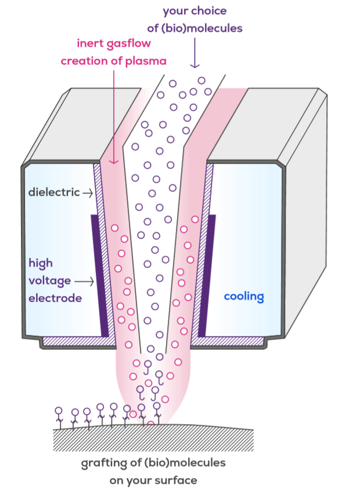
All these benefits are now possible with atmospheric plasma deposition, named by RELIANCE partner MPG “molecular plasma coating”. Simply put, it works by replacing aggressive chemical energy with a little bit of electricity. An electrical field excites an inert gas like nitrogen, creating a “plasma” (like in the neon lamps). This “cold” plasma is then used to apply coatings and permanently bond organic molecules onto any substrate.
PlasmaLine linear head: homogeneous plasma coating of 40 cm width

The plasma excites the surface and the chemistry, they react, and here we go with having a coated, functional surface. This can be done on an industrial scale.

Contrary to other plasma processes, this one takes place at atmospheric pressure, room temperature and at extremely low energy levels. Unlike the previous vacuum-based batch processes, the cold atmospheric plasma process is continuous. It is both environmentally sustainable and enables working with highly sensitive molecules such as the peptides being developed in the RELIANCE project. The bonus for healthcare applications is the possibility to use pure active ingredients, without the need for solvents, binders or curing agents that often become a biocompatibility hurdle. The low energy and temperature plasma allows for a wider range of organic chemistry and biomolecules, which is the main reason it was chosen as one of the coating methods in the RELIANCE project.

Tangible reduction in environmental impact

MPG’s process numbers speak for themselves when evaluating impact on the environment. The consumption of chemical precursors is in the order of less than 1 milligram per square meter of treated area, compared to grams for traditional coatings. The use of energy is in the order of 0,002 kWh per square meter when treating films continuously, almost negligible compared to the energy needed to cure and dry traditional wet coatings.

A European technology with EU support from member states Molecular Plasma Group was created as a spin-off from the Luxembourg Institute of Science and Technology (LIST) and the Flemish Institute for Technology Development (VITO). Its revolutionary cold atmospheric plasma technology has been described as ‘magic’ due to its limitless application potential. It is already being used in healthcare, aerospace, automotive, electronics and other applications. The machines are made in Belgium from mostly EU-sourced components.

Categories
News

Effect of pH, Temperature, Molecular Weight and Salt Concentration on the Structure and Hydration of Short Poly(N,N-dimethylaminoethyl methacrylate) Chains in Dilute Aqueous Solutions: A Combined Experimental and Molecular Dynamics Study

Authors: Dimitris G. Mintis, Marco Dompé, Panagiotis D. Kolokathis, Jasper van der Gucht, Antreas Afantitis and Vlasis G. Mavrantzas

Abstract

We study the microstructural properties and state of hydration of aqueous low-molecular-weight poly(N,N-dimethylaminoethyl methacrylate) (PDMAEMA) solutions and their dependence on polymer concentration and pH by means of detailed atomistic Molecular Dynamics (MD) simulations and experiments. For infinitely dilute solutions with a degree of polymerization of N = 30 at basic pH conditions, no temperature dependence is observed on the overall shape and state of hydration of the polyelectrolyte. This is supported by the experimental component of our work according to which the hydrodynamic radius, Rh, does not change dramatically with temperature. Small, but not drastic, changes are observed for solutions with longer PDMAEMA chains (N = 50, 70, and 110). Although the
MD simulations demonstrate that temperature and salt do affect the strength of hydrophobic interactions between PDMAEMA and water, apparently these effects are not strong enough to cause drastic changes to the overall shape of the polymer. MD simulations also reveal that Na+ salt ions strongly interact with the oxygen atoms located at the side chain of the polyelectrolyte. While no significant changes in the global shape or state of hydration of the PDMAEMA chain are found, a strong dependence is revealed for the aggregation behavior of the polymer on temperature and salt in slightly more concentrated solutions. A structural transition from a collapsed coil to a stretched conformation is also observed as we move from basic to acidic pH conditions, which is strongly correlated with the degree
of chain rigidity as a function of pH.

Follow the link to read the full article https://doi.org/10.3390/polym17162189

Categories
News

PESTLE for Innovation – the bigger view

Every project exists within its environment, and its success is, to some extent, influenced by external factors – this is especially important for innovative projects that cannot rely on the example of existing ones. This makes PESTLE an important tool in support of innovative projects, such as RELIANCE.

WHAT IS PESTLE?
PESTLE is a strategic management tool that contains a simple structure that enables a systematic assessment of external factors that can potentially impact the project’s success.

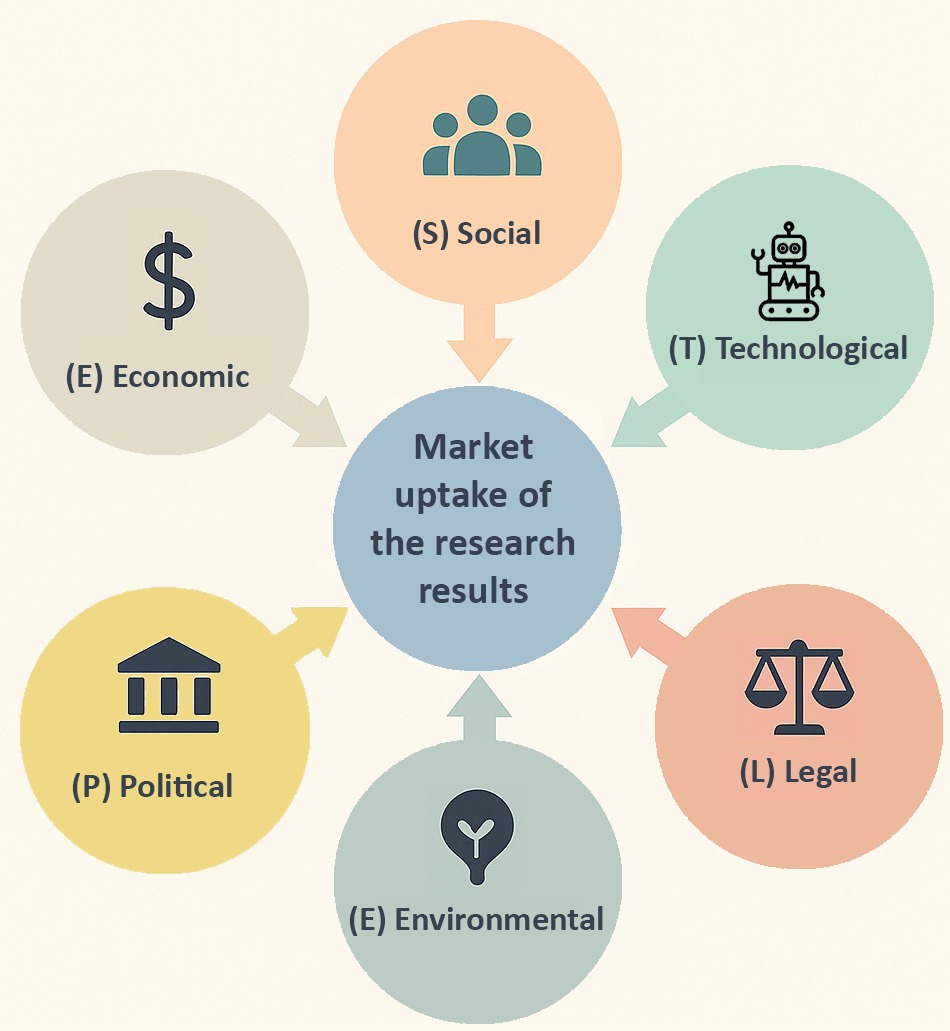
As its name suggests, PESTLE is about assessing the Political, Economic, Social, Technological, Legal, and Environmental factors connected to the project’s objectives. It helps in understanding the project’s macro-environment, identifying potential threats and opportunities for innovation, and supporting marketing and communication strategies.

  • Political factors refer to elements such as political stability in the region, the regulatory environment, funding policies, and R&D incentives. These are particularly important for research projects relying on public funding. These aspects will also impact the investment levels, which in turn affect the market uptake of the innovative products.
  • Economic factors include aspects such as economic growth/slowdown, business investment, interest and inflation rates, public spending, spending habits, labour costs, raw material costs, and exchange rates. These elements will impact the market uptake of innovations.
  • Social factors involve population growth, age, lifestyle, attitudes, and opinions. Their characteristics are determinant for the success of an innovation in the market.
  • Technological factors include factors such as the level of innovation in the area, the technological maturity of the market concerned, technological awareness, and new ways of communicating.
  • Legal factors include consumer rights and laws, as well as product labelling and product safety standards. They are particularly important for innovative products.
  • Environmental factors relate to environmental changes that can affect business practices, as well as to the environment-related policies.

WHEN TO START WITH PESTLE?
PESTLE can be highly valuable from the very conception of the research project. From early stages, it helps identify the opportunities that the environment offers and the threats that can challenge the project and its results.

PESTLE should be conducted at important milestones of a research project to reassess the project’s feasibility in a constantly evolving world.

Contributor: Dr. Arbesa Shehu Gremaud, HES-SO, Switzerland